What international companies need to know before hiring in Spain: how to employ people, contracts and probation, employer costs, leave and dismissal rules.
This guide looks at the state of the European tech talent market in 2026, how salaries compare between major cities, the options for employing people across borders and why Spain has become one of the most popular places to build a team.
According to Eurostat’s Digitalisation in Europe 2026, more than 10 million people worked as ICT specialists in the EU in 2025, about 5% of all employment. That is a long way short of the EU’s target of 20 million ICT specialists by 2030.
The shortage shows up in day-to-day hiring. In Eurostat’s survey of businesses, a lack of applications was the most common reason ICT roles were hard to fill, reported by 43% of companies that recruited ICT specialists (VDS). Women also make up only around one in five ICT specialists in the EU, which narrows the pool further.
Competition is fiercest for senior engineers, AI and machine learning specialists, data engineers, and security and platform roles. These people rarely apply to job adverts. They have to be found and persuaded.
Pay varies hugely across Europe. These are the median software engineer salaries reported to Euro Top Tech by engineers in each city (gross per year, November 2026):
Self-reported figures lean towards experienced engineers at international companies, and some cities have small samples, so treat them as a guide rather than a budget. Two things stand out. First, Central and Eastern Europe is no longer automatically cheaper for senior talent: in this data, Kraków and Warsaw report higher medians than Berlin. Second, Spain and Portugal still offer experienced engineers well below London, Amsterdam or German salaries.
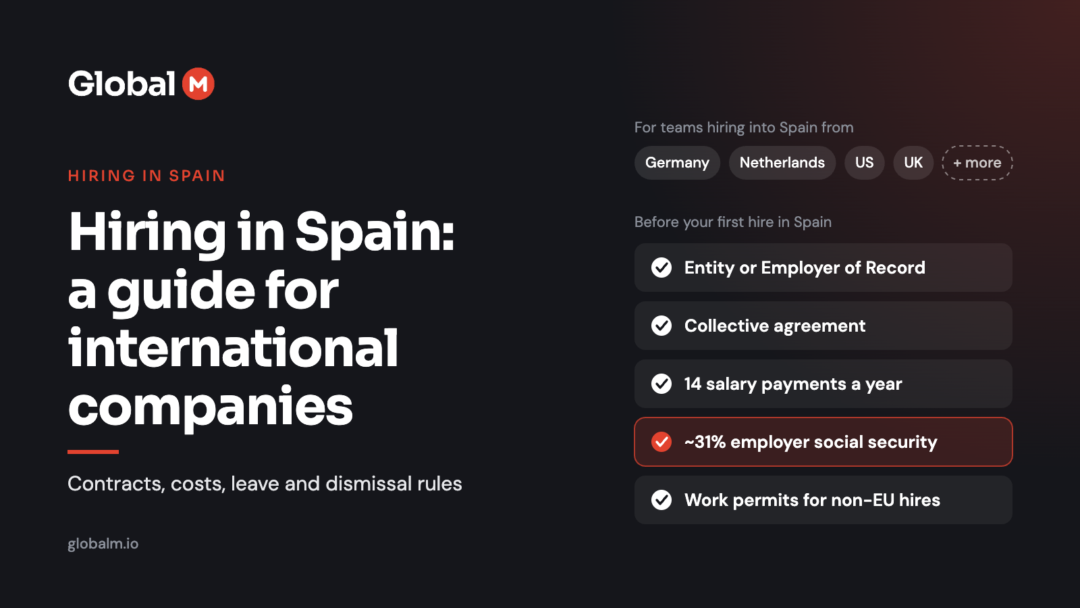
Salary is only part of the cost. Employer social charges vary widely between countries, and in Spain they add around 30% on top of gross pay, so always compare the total cost of employment, not just salary.
Finding the right person is only half the job. You also need a legal way to employ them:
Employment law also varies. Notice periods, probation, dismissal rules and statutory extras, such as Spain’s 14 salary payments a year, differ by country, so build them into your offers and budgets from the start.
Spain has become one of the most popular places for international companies to build tech teams:
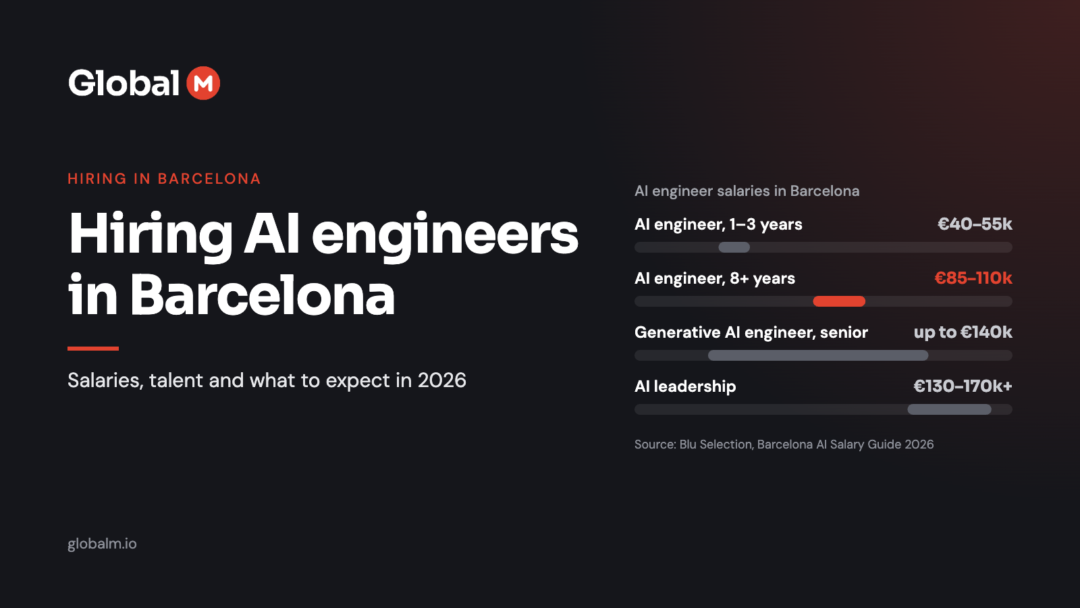
Our guides to hiring in Spain and hiring AI engineers in Barcelona go into more detail.
Global M is a talent consultancy headquartered at Barcelona Tech City, with offices in London, Madrid, Cambridge, New York and Johannesburg. Since 2012 we have helped companies hire in more than 40 countries. With an Embedded Hiring Team, a dedicated Talent Partner joins your team to run hiring across Europe for one monthly fee. For individual key roles, Success-Based Hiring means you only pay when you hire.
Active subscribers
Stay ahead of the curve in the ever-evolving world of recruitment. Our newsletter keeps you in the loop with the latest industry trends, providing valuable insights for both companies and job seekers.