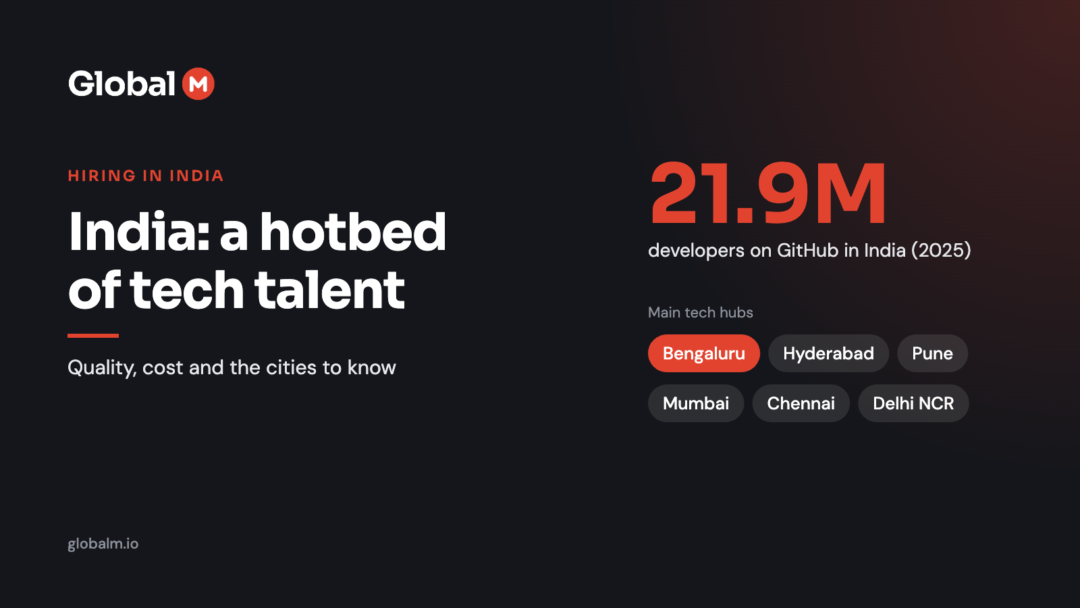
India's tech talent pool is huge, its quality keeps rising and it is far more cost-effective than the US or Europe. Here is what we have learned hiring there.
Key points
Experienced technical people rarely describe everything they’ve done on their profile. A Senior DevOps Engineer may have deep cloud infrastructure experience without listing every tool they’ve used. A software engineer may have worked with a framework or architecture for years without mentioning it in their summary.
A keyword or Boolean search only finds what people have written down, so it misses those candidates. For a company hiring, that means a narrower shortlist and more time spent screening profiles that look right on paper but aren’t. AI sourcing platforms take a different approach: you describe the experience and background you need, and the tool looks for people whose career history fits.
For an embedded recruiter, that matters. The goal is to reach the right people sooner without losing the quality and personal approach our clients expect.
At Holafly I worked as an embedded Talent Partner, as part of their team, hiring senior technical professionals. On these roles the detail of someone’s experience matters more than their job title.
One example was a Senior DevOps Engineer role that needed Google Cloud Platform (GCP) experience. Finding DevOps engineers wasn’t the hard part. Finding ones with the right GCP background was. Juicebox let me search beyond job titles and surface relevant experience that wasn’t obvious from a standard LinkedIn search.
The platform was intuitive and fitted into my existing sourcing approach with little adjustment. What stood out was the speed: searching in plain English felt almost as quick as using ChatGPT. When you’re working on several roles at once, less time spent building searches and screening irrelevant profiles makes a real difference. Speed only helps, though, if the people it finds are relevant.
40 targeted outreach messages. One successful technical hire.
By combining AI-assisted sourcing with personalised outreach and human recruitment expertise, we achieved a 2.5% outreach-to-hire conversion rate on the Holafly project. Candidate discovery was also faster, and the pipeline more relevant.
Why does that matter? With senior specialists, the aim isn’t volume. It’s a short list of the right people. Forty messages is a focused list, not a mass campaign, and it produced a hire. That tells me the searches were surfacing people worth contacting rather than adding noise.
It’s important not to overstate it. These numbers come from one project, not a side-by-side comparison with traditional sourcing, and I wouldn’t credit the placement to Juicebox alone. A hire also depends on understanding the role, engaging the candidate, running the interview process and building the relationship. What the project did show is how AI sourcing can make a specialist search more efficient.
Two features were most useful:
Juicebox also surfaced extra signals, such as recent career moves and possible work-authorisation details, which helped me decide which profiles to look at more closely. That information is inferred, so I always confirmed it directly with candidates before relying on it.
The biggest benefit wasn’t more profiles. It was finding suitable candidates more efficiently.
AI improves discovery. Recruiter judgement is still what makes a hire.
Juicebox is one of a wider group of AI sourcing tools. My own experience is with Juicebox only, but other platforms in this space include:
The point isn’t to use AI for its own sake. It’s to find the tools that genuinely make hiring better for our clients and their candidates.
My experience says AI will change how recruiters work, but it won’t replace the relationships that make hiring work. Finding a candidate is only the start. You still need to understand what motivates them, explain the opportunity, answer their concerns and earn enough trust for them to consider a move. That matters most with senior specialists who aren’t actively looking.
AI can find someone with the right experience. Persuading them to consider your role takes human understanding, credibility and good communication.
With Global M’s Embedded Hiring Team, experienced Talent Partners like me join a client’s team, work alongside hiring managers and take ownership of hiring, as I did at Holafly and as our Talent Partners have done for Celonis. AI sourcing makes that model stronger, but only because of the people using it:
For companies that need individual specialist hires rather than an embedded team, the same approach sits behind our Success-Based Hiring. You can compare both on our hiring models page.
I would use Juicebox again. In my experience, AI sourcing:
On the Holafly project it contributed to a placement from 40 targeted messages, but the tool was only as good as the brief, the prompts and the conversations behind it. That’s why recruiter expertise remains essential: knowing the technology well enough to search for it, judging who is genuinely a fit and building the trust that turns a profile into a hire. The best results come from combining AI sourcing with that human judgement.
In my experience, yes. At Holafly it helped me find relevant senior DevOps and engineering candidates faster, especially for skills that people don’t always list on LinkedIn. It works best in the hands of a recruiter who understands the role.
A Boolean search matches the keywords on a profile. An AI sourcing tool lets you describe the experience you need in plain English and ranks people on how well their background fits, so it can surface candidates whose profiles don’t use your exact keywords.
Treat it as a lead, not a fact. Inferred skills, career changes and work-authorisation details must be checked directly with the candidate before they are used in any hiring decision, and handled in line with data protection rules.
No. AI can help find people with the right experience, but convincing a senior specialist who isn’t looking to consider a move still takes a human: understanding what motivates them, explaining the opportunity and building trust.
If you’re hiring software engineers, DevOps or cloud specialists, we’d be glad to talk through how we’d approach it, whether that’s an Embedded Hiring Team working inside your business or Success-Based Hiring for individual roles. Book a free 20-minute call, or see examples of our technology recruitment in our case studies.
Further reading: Technology and AI recruitment articles, how to use AI in recruitment for candidate matching and bias reduction and in-house recruiter vs embedded hiring team vs recruitment agency.
Recruitment insights on LinkedIn
Stay ahead of the curve in the ever-evolving world of recruitment. Our newsletter keeps you in the loop with the latest industry trends, providing valuable insights for both companies and job seekers.