Your first AI engineer will shape your product and your next hires. Here is how to define the role, set the budget, assess real skills and close the offer.

This guide explains why hiring demand is so uneven, the options for scaling your recruitment team flexibly, and how to choose the right approach.
Very few companies hire at the same pace every month. Hiring tends to come in waves:
Between those waves, hiring often slows right down. If you have built a large permanent recruitment team for the peak, you now have more recruiters than roles. If you haven’t, the peak overwhelms your HR team and hiring managers, roles stay open for months, and growth plans slip.
A permanent recruiter costs more than their salary. You also pay employer National Insurance and benefits, recruitment tools and job board licences, and the management time to hire, train and support them. Then there is the time it takes to hire them in the first place. UK roles take around 40 days to fill on average, and a good recruiter then needs time to learn your business before they are fully productive. By the time your new recruiters are up to speed, part of the hiring window may have passed.
The bigger risk is the end of the wave. Reducing a permanent team is slow, costly and hard on morale, so companies often carry extra recruitment cost long after it’s needed.
An embedded hiring team, also known as embedded recruitment or embedded RPO, gives you dedicated recruiters from an external partner who work inside your business. They use your systems, represent your company to candidates and run hiring end to end, but they are not on your payroll. You can add capacity for a growth phase and reduce it afterwards.
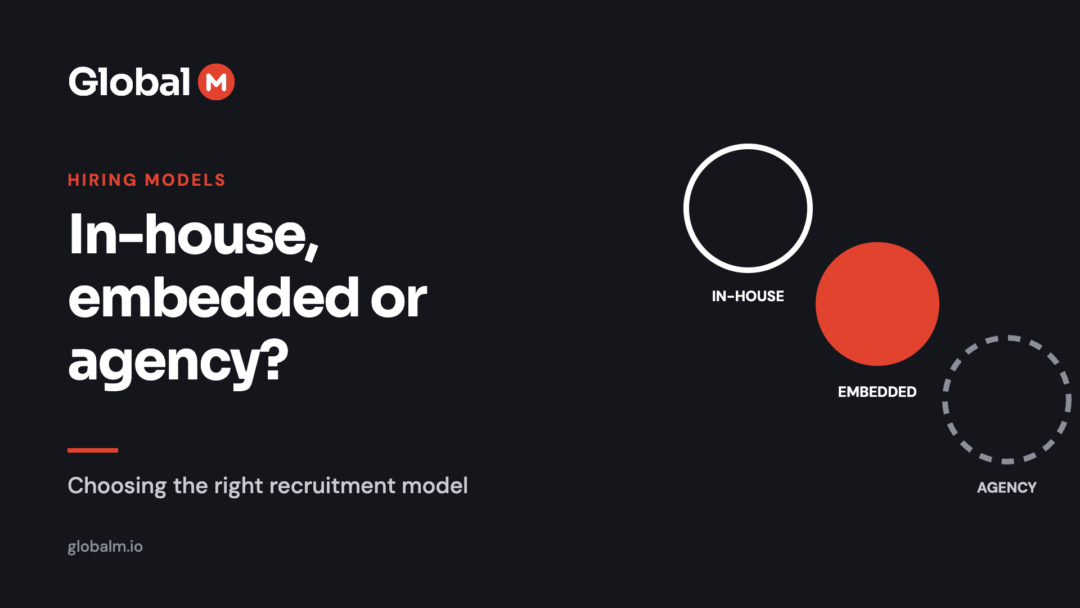
This is usually the most effective option when you have many roles to fill over several months. We compare it with other models in in-house recruiter vs embedded hiring team vs recruitment agency.
Freelance or contract recruiters can fill short-term gaps. They work well for a few months of extra capacity, but you still have to find them, manage them and provide their tools, and quality varies. When the contract ends, their knowledge goes with them.
For occasional senior or specialist roles, a contingency agency or success-based partner can take work off your team without any fixed cost. The trade-off is price: fees are usually a percentage of each hire’s salary, so this becomes expensive at volume.
Sometimes the problem is not the number of recruiters but how much of their time goes on low-value work. Before adding capacity, look at:
Our guide to the recruitment process from kick-off to offer covers each stage in detail.
Many scale-ups keep a small permanent talent team that owns hiring process, employer brand and stakeholder relationships, and add an embedded team when hiring increases. This gives you continuity and control, without the fixed cost of a team sized for your busiest month.
Start with your hiring plan for the next twelve months and ask:
Whichever model you choose, a scalable recruitment set-up should give you:
Measuring the right things matters here. According to the CIPD, only 31% of UK organisations track time to hire, as reported by TestGorilla. If you don’t measure it, it is hard to know whether adding recruitment capacity is working.
With Global M’s Embedded Hiring Team, dedicated Talent Partners join your team to run hiring end to end. You can be live within seven days, pay one monthly fee with unlimited hires, and track every role in live dashboards. When your plan changes, your recruitment capacity changes with it.
Book a free 20-minute call to talk about your hiring plan.
Further reading: Why RPO is the smartest recruitment strategy for 2026.
Active subscribers
Stay ahead of the curve in the ever-evolving world of recruitment. Our newsletter keeps you in the loop with the latest industry trends, providing valuable insights for both companies and job seekers.