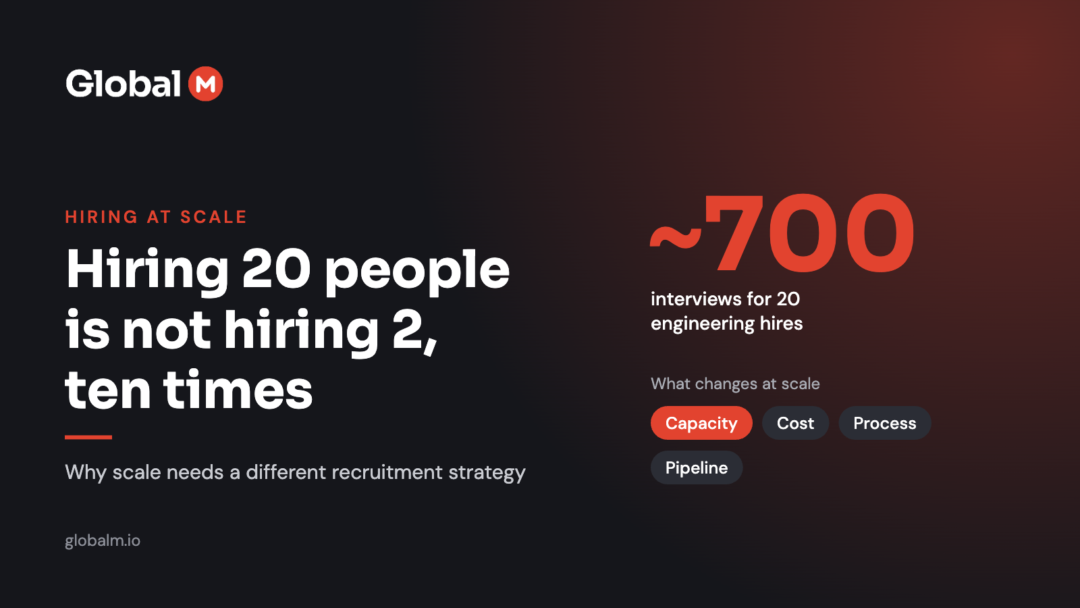
The approach that fills one or two roles rarely works for 20. Why scaling hiring changes the maths, and how to plan capacity, cost and process for a hiring plan that big.
Key facts
When companies compare hiring locations, they usually compare salaries. That understates the gap. The full cost of a software engineer has four parts:
The first two make up the bulk of the annual cost. The last two are one-off, but for a growing team hiring several engineers a year they add up quickly.
These are median total compensation figures (base, bonus and equity) for software engineers, from Euro Top Tech‘s community salary data, read in November 2026. Senior medians are shown where there were enough senior reports.
| Country | Senior median | All levels median |
|---|---|---|
| Switzerland | €141,000 | €130,000 |
| United Kingdom | €117,000 | €105,150 |
| Ireland | not published* | €120,000 |
| Netherlands | €108,000 | €100,000 |
| Poland | €99,383 | €93,960 |
| Germany | €95,000 | €85,000 |
| Sweden | €78,600 | €69,700 |
| France | €70,000 | €70,000 |
| Spain | €70,000 | €66,000 |
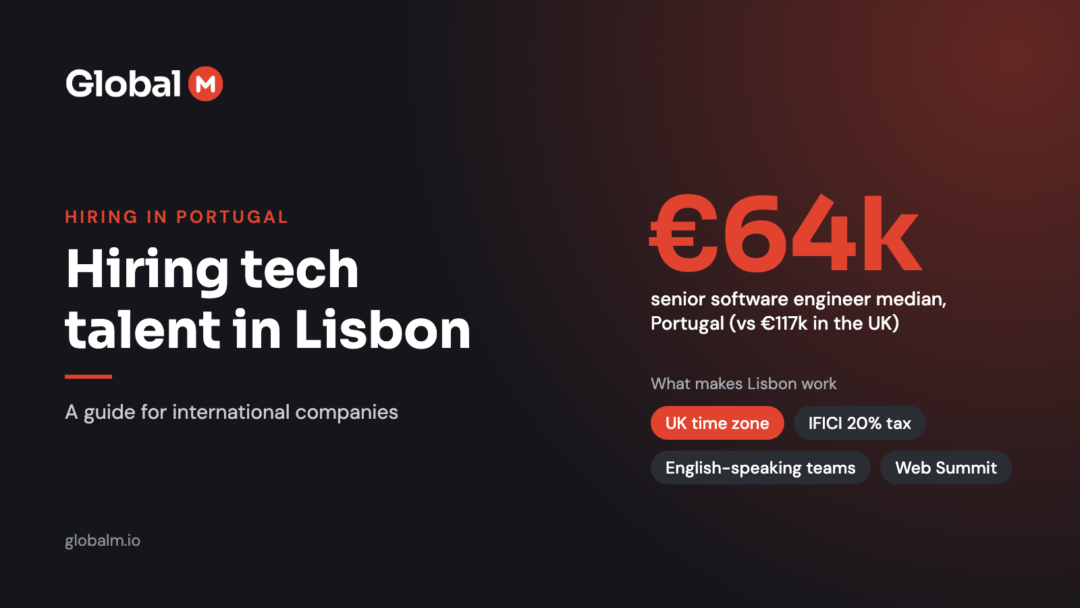
| Portugal | €64,000 | €50,000 |
*Too few senior reports for a reliable median. Figures are self-reported and, as the source notes, lean towards the upper end of the market (international product companies rather than local services firms), so treat them as benchmarks for competitive hiring rather than national averages.
Two things stand out. First, the gap between countries is large: a senior engineer in Portugal earns less than half the Swiss median. Second, the upper end of the Polish market now pays close to Germany, because many Polish engineers work for international companies and are paid accordingly.
Employer contributions vary even more than salaries. The table below applies the approximate employer rates reported by HTLC Network to the senior medians above to give an indicative annual cost of employment.
| Country | Employer social security (approx.) | Indicative annual employer cost, senior engineer |
|---|---|---|
| Switzerland | 12–13% | about €158,000–159,000 |
| United Kingdom | 15% above a £5,000 threshold | about €134,000 |
| Netherlands | about 27.65% | about €138,000 |
| Ireland | 11.25% (PRSI, rising to 11.40%) | about €133,500 (all-levels median) |
| Poland | about 19–22% (pension and disability capped) | about €118,000–122,000 |
| Germany | about 21% | about €115,000 |
| France | about 42–45% | about €99,000–102,000 |
| Spain | about 30–31% | about €91,000 |
| Portugal | 23.75% | about €79,000 |
Indicative only. Several countries, including Germany, Spain and the Netherlands, cap some contributions above a salary ceiling, so the effective rate for senior engineers is often lower than the headline figure. Rates change, so confirm current rules locally or with your payroll provider before budgeting. Sweden is not covered by the source.
France is the clearest example of why salary alone misleads: a senior engineer there earns about the same as in Spain, but costs roughly 10% more to employ because employer contributions are higher.
On top of employment costs, you have to find the engineer. There are three main routes:
Don’t forget the cost of time. UK roles take around 40 days to fill on average (SmartRecruiters data, reported by TestGorilla), and senior engineering roles often take longer. Every week a role is open is a week of delayed product work, and the longer a search runs, the more likely you are to lose good candidates to faster competitors.
The cheapest location is not always the best one. A role that takes four months to fill in a lower-cost market can cost more overall than one filled in six weeks elsewhere. Our guide to hiring tech talent in Europe covers where each skill set is strongest.
Global M has hired software, data and infrastructure engineers across Europe for international companies since 2012. For Adevinta, our Talent Partners made 42 hires in 12 months across roles such as data, machine learning, DevOps and back-end engineering (read the case study). For OLX Group, an embedded team made 36 hires, including the VP of Engineering (read the case study).
For individual senior hires, Success-Based Hiring means you only pay when you hire. If you’re building a team across one or more countries, an Embedded Hiring Team gives you dedicated Talent Partners for a predictable monthly cost.
Median total compensation for senior software engineers ranges from about €64,000 in Portugal to €141,000 in Switzerland (Euro Top Tech, November 2026). Employer social security adds roughly 12% to 45% on top, depending on the country.
Among Europe’s main tech hubs, Portugal and Spain have the lowest total cost, with senior medians of about €64,000 and €70,000 and employer contributions of 23.75% and around 30%.
Approximate employer rates range from about 12–13% in Switzerland and 15% in the UK to about 21% in Germany, 23.75% in Portugal, around 30% in Spain and 42–45% in France. Several countries cap contributions above a salary ceiling.
Contingency fees for technology roles are typically 18 to 22% of first-year salary, and more for niche skills. On a €70,000 salary that is €12,600 to €15,400 per hire.
Yes. Global M hires engineers across Europe through Success-Based Hiring for individual roles and Embedded Hiring Teams for companies making several hires, and has made hires for clients including Adevinta and OLX Group.
If you’d like a second opinion on where to hire and what to budget, book a free 20-minute call with our team.
Further reading: cost of hiring tech talent in Spain and hiring AI engineers in Barcelona.
Recruitment insights on LinkedIn
Stay ahead of the curve in the ever-evolving world of recruitment. Our newsletter keeps you in the loop with the latest industry trends, providing valuable insights for both companies and job seekers.