AI can now source, screen and schedule. So will it replace recruiters? A practical look at what AI does well in talent acquisition, where it falls short and how the recruiter's role is changing.
Key points
| Hiring 2 people | Hiring 20 people | |
|---|---|---|
| Approach | Individual searches | A hiring plan with priorities, timelines and budget |
| Who recruits | Founders, managers or an agency | Dedicated recruitment capacity |
| Interviewing | A few interviews squeezed into the week | Hundreds of interviews needing trained, calibrated interviewers |
| Process | Flexible, informal | Structured and repeatable, with clear stages and scorecards |
| Sourcing | Adverts, referrals, one-off searches | Talent maps, pipelines and ongoing sourcing |
| Cost | Per-hire fees are manageable | Per-hire fees add up fast; a fixed model is often cheaper |
| Measurement | Did we fill the role? | Time to hire, conversion rates, cost per hire and quality of hire |
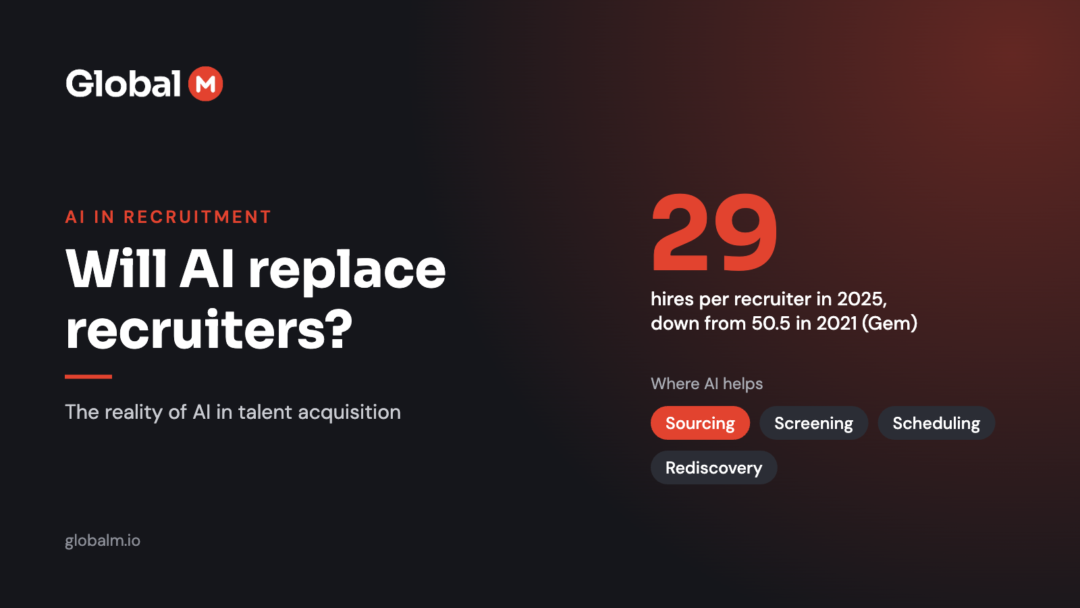
Every hire takes far more effort than the offer itself. According to Gem, it takes around 35 interviews to make one engineering hire, and recruiters made an average of 29 hires each in 2025. Scale that up and 20 engineering hires could mean around 700 interviews, plus the sourcing, screening, scheduling and feedback behind them. That workload is far more than a founder or hiring manager can absorb alongside their day job, and more than one recruiter working on many other roles can deliver quickly.
When capacity runs short, the symptoms are familiar: interviews get pushed back, feedback slows, candidates accept other offers and hiring targets slip quarter after quarter.
Contingency agency fees are commonly 18–22% of first-year salary (Recruitly, 2026). For one or two hires that can be the most sensible option. At volume the maths changes:
| Number of hires | Average salary | Fee at 20% |
|---|---|---|
| 2 | €70,000 | €28,000 |
| 10 | €70,000 | €140,000 |
| 20 | €70,000 | €280,000 |
These are illustrative figures, but the point holds: per-hire fees scale linearly with your hiring plan. A model with a fixed monthly cost, such as embedded recruitment or RPO, means the cost per hire falls as volume rises. See how much it costs to hire a software engineer in Europe for salary benchmarks.
With two hires, an informal process is manageable. With 20, different interviewers asking different questions and applying different standards leads to inconsistent hiring decisions, a poor candidate experience and avoidable bias. Volume hiring needs clear stages, structured interviews, agreed scorecards and interviewers who have been trained and calibrated.
Starting each search from scratch when a role opens is slow. At scale you need to know where the talent is before you need it: which companies employ the people you want, where they’re based, what they earn and what would make them move. Talent maps and warm pipelines let you fill roles in weeks rather than months, and hiring similar roles in cohorts (for example, five back-end engineers at once) saves effort on every stage.
Global M’s Embedded Hiring Team gives you dedicated Talent Partners who join your team, run your hiring plan end to end and report on progress through live dashboards, for one monthly fee with no per-hire fees. Find out more in what is embedded recruitment and how does it work? and how to scale your recruitment team without increasing headcount.
At volume, the workload, cost and need for consistency all grow. Twenty engineering hires can mean around 700 interviews, per-hire agency fees add up quickly and an informal process leads to inconsistent decisions.
Gem reports around 35 interviews per engineering hire, so 20 engineering hires could take around 700 interviews, plus sourcing, screening and scheduling.
Agencies suit one-off or occasional hires. For a plan of 10 or more hires, embedded recruitment or RPO usually gives more capacity, a consistent process and a lower cost per hire because you pay a fixed fee rather than a fee per hire.
Agree a prioritised hiring plan, put dedicated recruitment capacity in place, map the market, standardise the interview process, protect interviewers’ time and track your recruitment KPIs weekly.
Book a free 20-minute call to talk through your hiring plan.
Recruitment insights on LinkedIn
Stay ahead of the curve in the ever-evolving world of recruitment. Our newsletter keeps you in the loop with the latest industry trends, providing valuable insights for both companies and job seekers.