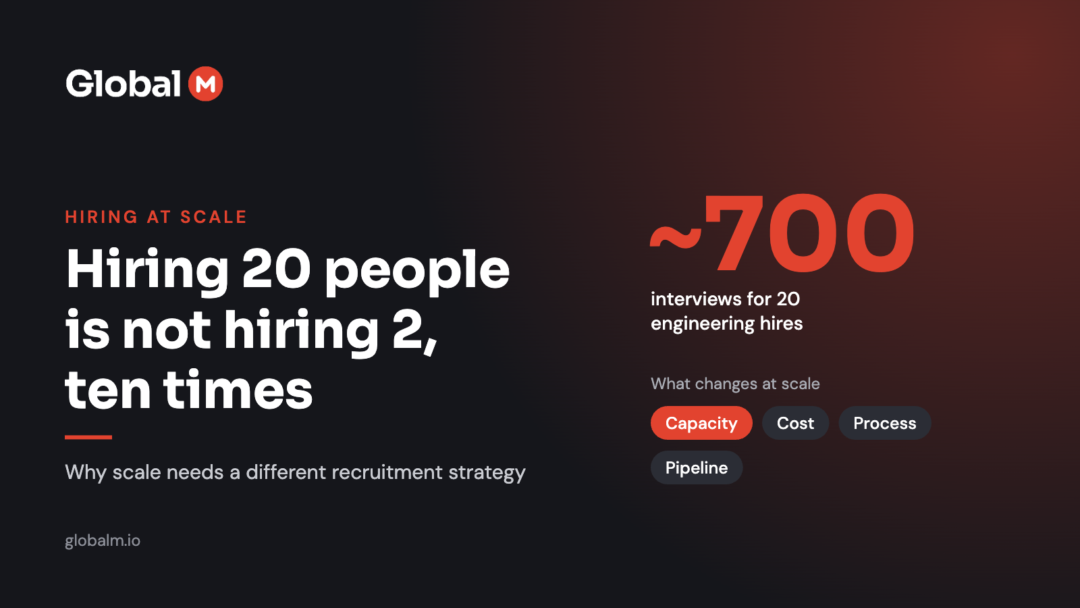
Lo que funciona para uno o dos puestos rara vez funciona para 20. Por qué escalar la contratación cambia las cuentas y cómo planificar capacidad, coste y proceso.
Key points
| Task | What AI does | Where humans still matter |
|---|---|---|
| Búsqueda | Searches in plain English, infers skills from career history and keeps searching in the background | Defining the right profile and deciding who is worth approaching |
| Outreach | Drafts personalised messages and follow-ups at scale | Building trust with senior people who aren’t looking |
| Preselección | Summarises CVs, ranks applications and flags must-have skills | Judging potential, motivation and fit; checking for bias |
| Scheduling and admin | Books interviews, sends reminders and updates the ATS | Handling exceptions and keeping candidates engaged |
| Rediscovery | Resurfaces past applicants and silver medallists already in your ATS | Deciding whether someone is right for this role, now |
Rediscovery is a good example of the gains available: Gem found that 46% of sourced engineering hires were rediscovered candidates already in the company’s ATS. AI makes that existing talent far easier to find.
Recruiters are handling more work per hire. According to Gem, hires per recruiter fell from 50.5 in 2021 to 29 in 2025, and it now takes around 35 interviews to make one engineering hire. More applications, many of them AI-written, means more noise to cut through. AI helps manage the volume, but someone still has to decide who is genuinely right.
The senior engineers, leaders and specialists most companies want are usually employed and not looking. An AI tool can find them. Persuading them to consider a move means understanding what motivates them, explaining the opportunity honestly, answering concerns and earning trust over several conversations. That is relationship work.
A good recruiter challenges the brief, tells the hiring manager what the market will and won’t support on salary, location and skills, and keeps the process moving. AI is only as good as the brief it’s given; a vague prompt gives vague results.
Only around 20% of organisations measure quality of hire (SHRM, 2025). AI can score keyword matches, but it can’t yet tell you reliably who will perform, stay and grow in your team. Assessing that takes structured interviews and experienced judgement.
AI screening can repeat the biases in the data it learns from, and AI-inferred details about a candidate can be wrong. Employers remain responsible for hiring decisions, so recruiters need to check what AI tools suggest, verify information with candidates and handle personal data in line with data protection rules. In the EU, the AI Act classes AI systems used for recruitment and candidate selection as high-risk, which brings extra obligations for the businesses that use them.
Our Senior Talent Partner Rupert Smith used the AI sourcing platform Juicebox while embedded with Holafly, hiring senior technical people. Plain-English search and AI sourcing agents helped him find candidates with specific Google Cloud experience that keyword searches missed. He sent 40 targeted outreach messages and made one successful technical hire, a 2.5% outreach-to-hire conversion rate. His conclusion: the tool made discovery faster, but every inferred detail still had to be checked and every candidate still had to be persuaded by a person. Read Rupert’s full account.
Tools such as Noon now go further, with AI agents that source, screen and contact candidates on a recruiter’s behalf. We expect more of the process to be automated. That makes the human parts of the job, and the quality of the people doing them, more important, not less.
Global M’s Talent Partners use AI sourcing and automation to find people faster, and spend the time saved on what makes hiring work: understanding your team, engaging candidates and running a fair, fast process. Through our Equipo de contratación integrado, they work as part of your team with modern tools behind them. For more on the tools, see how to use AI in recruitment for candidate matching and bias reduction.
AI is replacing many recruitment tasks, such as searching, first-pass screening and scheduling, but not the recruiter. Persuading people who aren’t looking, advising hiring managers, judging fit and closing offers still need human expertise.
AI can source candidates from plain-English descriptions, draft outreach, summarise and rank applications, rediscover past candidates in your ATS and automate scheduling and admin.
AI can repeat biases in its training data, infer candidate details incorrectly and create data protection obligations. Employers remain responsible for hiring decisions, so AI outputs need human review.
Yes. The EU AI Act classes AI systems used for recruitment and candidate selection as high-risk, which brings obligations such as human oversight and transparency for the businesses that use them.
Use it for repetitive tasks and wider searches, keep humans deciding who to contact, review AI rankings rather than accepting them automatically and measure the impact on time to hire and quality of hire.
Reserva una llamada gratuita de 20 minutos to talk about your hiring plans.
Claves de selección en LinkedIn
Mantente a la vanguardia en el mundo de la selección, en constante evolución. Nuestra newsletter te mantiene al día de las últimas tendencias del sector, con ideas valiosas tanto para empresas como para quienes buscan empleo.